Our printer’s been broken.
The past couple weeks I’ve been going to Office Max to print out the letters I send (I type ‘em, owing to how horrible my handwriting is).
Couple Sundays ago I didn’t make it before they closed. So the next morning I decided to email my daughter the letter I meant to send.
I had a hunch that her Monday might appreciate a flotation device.
Probably because I knew my Monday would appreciate a flotation device.
“I needed this today,” she wrote back later that night, acknowledging a few of the unexpected life and health plot twists that have been ganging up on her.
But then she wrote this …
“I’ve recently taken solace in the fact that this is a just a week in the season of college. Like all seasons, it is temporary. It is also a privilege. The rainfall of spring is yearned for in August and winter hungers for summer’s heat. There’s a lesson in that I think.
“So, it would seem, it is not All Bad.
“Barring tragedy, a month from now I will be leaving for Ireland, having survived the midterms and late-night rehearsals and daily small annoyances and whatever other pileups on I-76 happen between now and then.
“Our only job is to stay afloat in the interim, holding on to as many small, wonderful things as we can.”
Meet my new favorite writer.
She signed off with, “Loquaciously yours.”
“I needed this today,” I have found myself thinking pretty much every day since.
I keep coming back to the same nine words like a campfire.
“So, it would seem, it is not All Bad.”
Such tender stitching across those nine syllables.
I love the commas so much.
Technically speaking they’re not necessary.
But I also think that’s what makes them essential.
Humble stakes in unsettled ground … to mark a deliberate consideration of the larger body of evidence.
The commas give “So” the space it needs to fulfill its destiny as a stunt double for “Therefore.”
“So, it would seem, it is not All Bad.”
I think I love “it would seem” even more.
How it stops just short of certain, while daring the reader to draw a different conclusion.
And the capitalization of “All Bad”?
It’s so good.
Puts it on a pedestal so the reader appreciates it’s not worthy of so lofty a perch.
In no way does it dispute that ‘it’ is, in fact, bad.
That bad exists.
That there will always (always) be bad.
It just doesn’t allow bad to hog the middle seat arm rest.
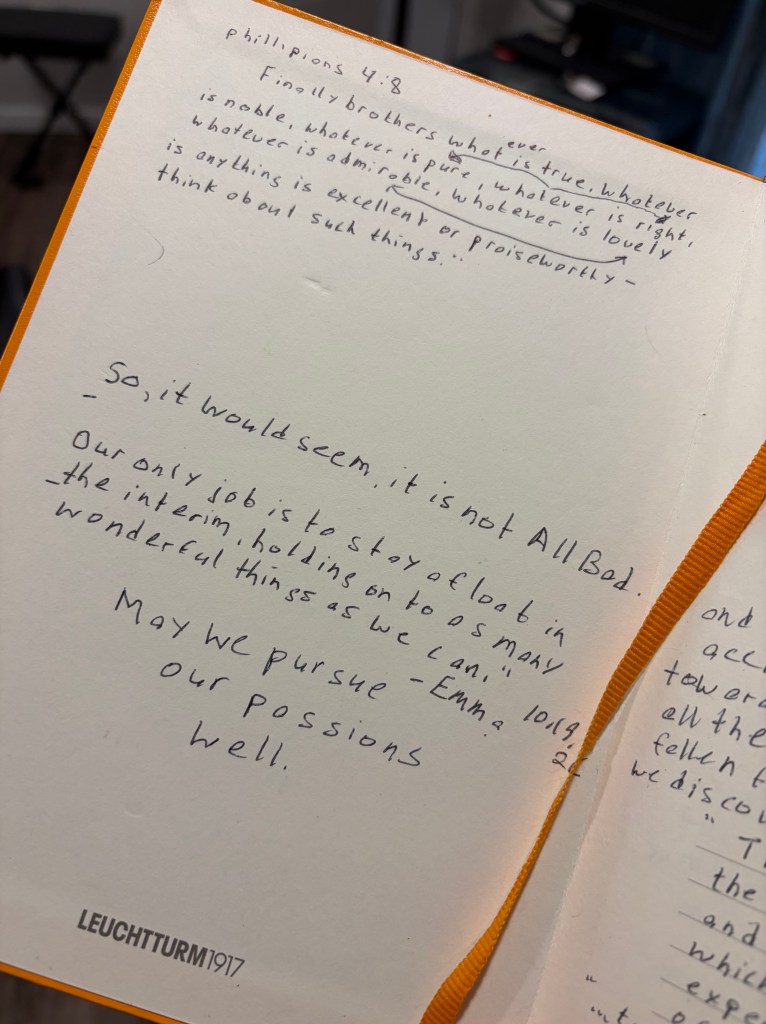
For the past couple weeks, those nine words have been sharing morning coffee in my heart with Philippians 4:8, which a friend recently gifted to me, and which I recently scribbled in my horrible handwriting — in all of St. Paul’s Comma glory — on the inside cover of my journal.
“Finally, brothers, whatever is true, whatever is honorable, whatever is just, whatever is pure, whatever is lovely, whatever is commendable … if there is anything worthy of praise, think about such things.”
Under which I scribbled Em’s loquaciousness.
It’s my experience that the small things do indeed make for the best flotation devices.
Like typed letters meant for the mail but broken-printer emailed on a Monday morning.
Needing only nine syllables to stitch wisdom worthy of stone tablets.
Humble commas that aren’t necessary, but show up for the protest anyway.
Capitalizing things to put them in their place.
Saints who remind us of the job description.
And scribbled journals in our messy handwriting … to help us, in the interim, hold on to as many small, wonderful things as we can.
LY,
Pete and Emma


