Type “cathedral” into my brain’s large language model, you’ll get an image of 261 Columbus Avenue in San Francisco’s North Beach.
This t-shirt unlocks so much for me … beginning and ending with the Pilgrimage.
Whenever work or friends would take me to San Francisco, I’d stay at the Hotel Rex on Sutter, which was part of Chip Conley’s Joie de Vivre collection of boutique hotels, each one inspired by a different magazine. The Rex was inspired by the New Yorker, and was designed to evoke San Fran’s literary salons of the 1920s and 30s.
Their lounge was The Library, all cushy chairs, reading lamps and the magical musty smell of old books (swoon).
Its atmosphere was cozily curated for unburdening … conducive to liberating one’s hands to alternate between a good book, a pen and paper, and a half-full glass of the house red.
Make a left exiting the hotel, I’d walk the few blocks down to Bush, hang a left and climb its hill to the iconic Dragon’s Gate.
From there take a savoring stroll through North America’s oldest and largest Chinatown, a world unto itself.
Keep walkin’ until I find North Beach. Make the right, slowing to a reverent saunter through Jack Kerouac Alley, pausing to bow and whisper read his pavement words etched in its center, “The air was soft the stars so fine the promise of every cobbled alley so great.”
And then, proof that alley promises come true: City Lights — Ferlinghetti’s fierce, tender, defiantly flickering eternal flame of a bookstore.
Every single second I’ve spent walking amongst its stacks has been a replenishing.
The sound of one’s shoes creaking its old wooden floors while in slow-browse reverie? A poetry all its own.
I love reading the staff’s hand-written recommendations slash love letters adorning the shelves as much as I do the books they hype.
The pleasure of stumbling upon treasure you didn’t even know to look for.
Going upstairs to the poetry room, where Ferlinghetti’s rocker — the ‘poet’s chair’ — still sits by the window in open invitation.
Harvesting an armful of sustenance for the suitcase home.
Walking back to the Rex drunk on Kerouac’s soft air and fine stars, clutching my brown paper bag tightly as I imagine he did his.
Joe Mugnaini’s brilliant cover for the first edition of Ray Bradbury’s incendiary novel.
The book holds a special place in my heart for a couple reasons, on top of its timeless cautionary tale.
My daughter and I read it aloud together across many Saturday coffee-shop mornings when she was a young teenager, which was my first re-read of it in a good 20 years or so. What a wonderful way to be reacquainted.
And during our re-reading, I was profoundly moved by a passage late in the book when Montag, on the run, encounters a group of kindred spirits living in the woods on the outskirts of town. And around a campfire, he remembers his grandfather. I can’t tell you how many times I’ve gone back to this passage since.
Its still glowing embers warm me as much as the campfire that coaxed the words from Bradbury’s typewriter.
It’s not only been medicine to my heart, but I’ve shared Bradbury’s beautiful words with friends and kindred spirits seeking warmth in the darkness of their own loss.
“Everyone must leave something behind when he dies, my grandfather said. A child or a book or a painting or a house or a wall built or a pair of shoes made. Or a garden planted. Something your hand touched some way so your soul has somewhere to go when you die, and when people look at that tree or that flower you planted, you’re there.
It doesn’t matter what you do, he said, so long as you change something from the way it was before you touched it into something that’s like you after you take your hands away. The difference between the (person) who just cuts lawns and a real gardener is in the touching, he said. The lawn-cutter might just as well not have been there at all; the gardener will be there a lifetime.”
Always makes me think of the gardeners I’ve known in my life.
While waiting for Nicole to deliver the first of her always luminous — and my requisite two — Saturday morning cortados at the tiny, tender coffee shop on North Main (which you should totally visit), I was perusing the small packs of Commonplace Coffee for sale near the counter, whose blends are always intentionally dedicated (they have one inspired by WYEP — a sonic apothecary of Pittsburgh’s airwaves for the past 50 years — called ‘Morning Mixtape’ [swoon]). Commonplace Coffee is a tender haven in its own right nestled in Pittsburgh’s North Side (which you should totally visit).
Unbeknownst to me, on the back of every one of Commonplace’s coffee packs is a Walt Whitman poem, evidently the inspiration for their name.
Stumbling upon such treasure was as much medicine for my morning as Nicole’s perfect cortados.
And too good not to share with kindred spirits.
Here’s to waiting / and finding Whitman waiting patiently / weighty on the backs of packs / whispering across centuries / seashell words washed ashore / waiting for waiting travelers willing to bow their heads / for a little light / to lighten their loads
Lydia and I met as freshman English majors at Waynesburg College. Had a bunch of classes together. Worked on the newspaper. Lydia was editor our senior year. I wrote a silly column trying too hard to be Dave Barry. Lydia was in charge of things.
Anyone who knows Lydia will not be surprised by this.
She expected a lot of herself, and of the world around her. I remember once she got so fired up upon learning that a classmate had been cheating in one of our classes.
“Pete! It’s just not fair! He’s not doing any of the work and he’s going to get the same grade as us!”
As an aside … she was being generous in including me in the ‘us’ part of the grade-getting.
“Doesn’t that make you mad?!?”
I remember answering her that what other people did didn’t bother me much. That maybe what mattered more was what we were learning … what we were getting out of the class … what we might take with us. I remember telling her that I wasn’t sure that the grade even mattered all that much.
Needless to say, I was unsuccessful in litigating that case with Lydia … who went on to be our class’s valedictorian, and graduate from law school after that.
I think our friendship was forever forged in Dr. McEwen’s Research Writing class. To say that Dr. McCewen was exacting would be an understatement. The entire semester was dedicated to writing a research paper. We would meet to work on it at Lydia’s sister’s apartment in downtown Waynesburg (quieter than the dorms).
Lydia was the organized one. She kept us on task. Made sure we hit our deadlines and turned everything in on time, if not early.
None of the above were among my superpowers.
In a spasm of poor decision making, Lydia let me choose the topic for our research paper. I remember wanting to look at different periods of history to see what given societies found funny, as reflected in their drama and literature. Like, what was funny in Shakespeare’s time? And to what degree did comedy stay the same or evolve across centuries and societies?
It looked good on paper.
It didn’t look good in our paper.
We’d be on like, draft 7, and Dr. McEewen would return it just bleeding red ink from his infamous pen. Lydia would get so stressed out. As the semester progressed, she doubled-down on editing our drafts before we had to re-submit. She had this big blue thesaurus. She would pull it out and make suggestions when we were stuck on something. This is one of the few things we clashed on. I’ve always hated thesauruses. Have always considered them a sign of weakness. Whenever she would bust out the thesaurus, I’d rebel. Ignored all of her suggestions. Told her we weren’t trying hard enough and would figure it out.
Aside from that, if I brought anything to our partnership, I think I helped keep things light … helped us from taking ourselves too seriously.
I think Lyd found me amusing … much the way one is amused watching a dog chasing its tail.
I could always make her laugh.
The LYDIA laugh.
It was glorious. More of a cackle, technically speaking.
And one, that for as long as I knew her, she never cut short for room or circumstance.
__
Our interactions during Dr. McEwen’s class would remain the hallmarks of our friendship after college.
Lydia remained the organized one, always taking the initiative in our remaining in touch. She’d send cards and thoughtful letters recounting her travels abroad and life updates. Which I would return weeks, sometimes months, later. She was meticulous about sending cards around the holidays. My birthday card from her would invariably arrive a couple days early.
By contrast, while I knew her birthday was in February, I could never remember the exact day. She’d always give me shit when it arrived days, or sometimes weeks, late. I remember once asking her to remind me when it actually fell. Her response, “I’m not telling you. You should know.”
She expected a lot of the world around her.
It got to the point where, when I’d see February approaching, I’d immediately send her a note, making a point of calling out how proactive I was being.
She didn’t buy it.
__
But there is one date that I know I will never, ever forget — Friday, June 7, 2024.
We had made plans earlier in the week to talk. She’d warned me in advance. “Brace yourself, Pete … it’s not good.”
When I picked up and told her I was driving, she said it was probably good that I was sitting down.
And for the next couple minutes, she — unflinchingly, unblinkingly, remarkably — let me know that it took her doctors three biopsies before they figured out what it was. That it was not the recurrence of breast cancer she and they first believed it to be. That it was worse. A rare form of cancer. Only 200 cases. And that it had spread all through her body. That she likely had a month to live. With treatment, maybe three months. Maybe a little longer.
She told me that I was the last person she planned to have this conversation with. That it was just so impossibly hard. That she was done recounting it all.
I mean, what do you say to that?
You start with what’s true.
I told her that I received both the act and substance of what she shared with me … as an honor … as a gift … as a blessing.
That she has always had such a light about her … and that light was as bright in this moment as it had ever been.
And that I would always do my very best to reflect her good light back to her, and to the world at large.
And you both cry a little bit, but not much. She’d done the crying.
So you do what you’ve always done for as long as you’ve known each other.
You just catch up.
You talk about Waynesburg. Old classmates. Dr. McEwen. Other professors.
In our reminiscing, I mentioned to her that I have few regrets, but I do regret that I was never able to go back and have an adult conversation with Dr. Bower, who was another larger-than-life character in our college experience. To talk about all the seeds he planted … his knowing we weren’t equipped in the moment for them but planting them anyway. I wished I could’ve told him what some of those seeds had come to mean for me.
When Dr. Bower passed away, Lyd and I went in on a memorial donation to the library in his honor.
In response to my ruminating, Lydia said the most remarkable thing.
She said, “I’d wish for the exact opposite.
“I’d just like to go back and have one day at college. Not even a special day. I’d just like to walk campus. Sit in on a boring class. Hang out in the dorm talking about nothing.
“Go to Scott’s Delight … get an Everyday Special.”
Scott’s was an unassuming greasy spoon down the road from campus. A counter with stools directly in front of you as you entered, and a few booths on either side of the entrance. The Everyday Special = legendary. You could get a burger, fries and a coke for like $1.85. Cup of nacho cheese to dip your curly fries would set you back another 45 cents. That’s how the pros did it, anyway.
It wasn’t great. But it was perfect.
An Everyday Special.
It was just the most golden thing for Lydia to say.
I was still letting it sink in when she continued.
“Oh, there’s something else I wanted to tell you.”
She said that she was hoping to surprise me, but she wasn’t sure she would get the chance, so she wanted to tell me just in case.
She asked me if I remembered seeing a few months ago that the college (I know it’s a fancy University now, but it will never be anything other than Waynesburg College to me) was doing a fundraiser for an Alumni Walk.
Um, I hadn’t seen it … to which she was not surprised.
She let me know that she made a donation … to which I was not surprised.
Until she added …
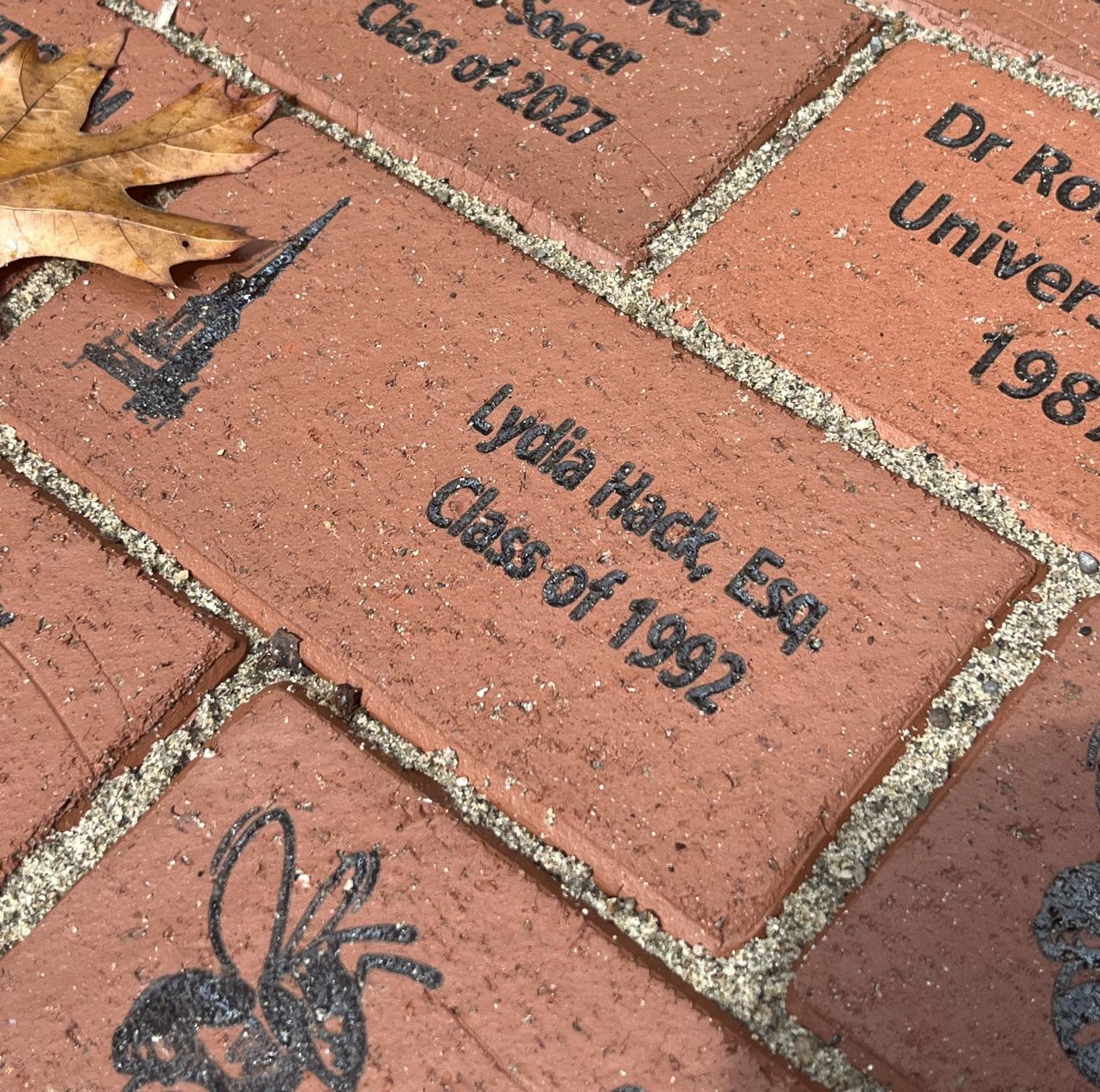
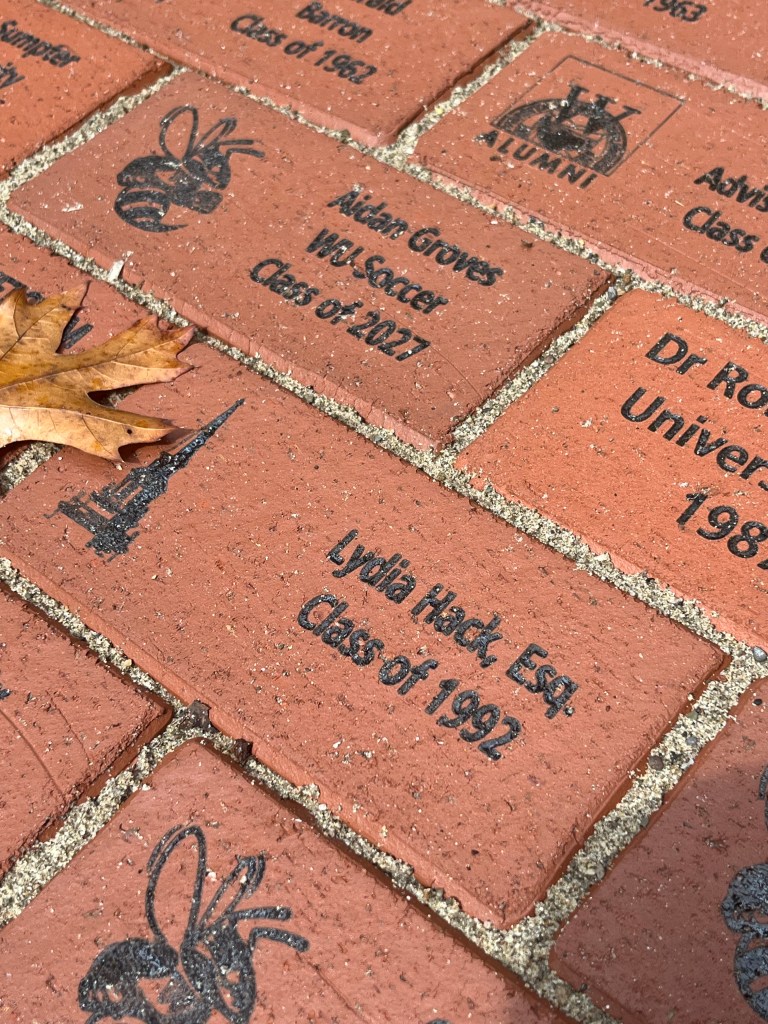
“I got us each of us a brick, Pete.”
Oh my gosh, I said aloud, pulling one hand off the steering wheel and placing it on my heart.
I mean, what do you say to that?
She said it for us.
“So we’ll always be together on campus.”
I was speechless.
I don’t remember what we chatted about after that.
I only remember one thing, actually.
At some point … I made her laugh.
Don’t remember what I said … most assuredly something dumb, like always.
But there it was.
The Lydia laugh.
Her singular cackle.
The one she never cut short — even in this impossible moment — for room or circumstance.
Undiminished. Resplendent.
__
Days later I found myself downstairs at my desk … still reflecting on our remarkable conversation … when it hit me.
I remembered something I hadn’t had occasion to think about for 35 years.
The kind of detail that Lydia was notorious for remembering … the kind I never could recall.
I remembered the title of our research paper.
And it about knocked me out of my chair.
In the shadow of our remarkable conversation, it was infused with a poignancy that I cannot adequately put into words.
The title of our paper was inspired by a story we’d come across in our research. The story is believed to be apocryphal, its exact source lost to history.
But the gist of it is this.
A famous actor was lying on their deathbed, being attended by family and friends come to pay their last respects. A former colleague was at the bedside, looking at the frail actor in their failing health. Piteously, the colleague said, “This must be so difficult for you.”
To which the actor opened their eyes and said in reply …
“Dying is easy. Comedy is hard.”
The memory hit me at the very moment I was thinking of the sound of Lydia’s laughter … from the last conversation we would ever have.
Lydia took the thesis from our paper and pretty much made it the thesis for a full life, well-lived. One she never stopped researching.
In the end she was litigating my case back to me. That when all was said and done … the grade didn’t matter after all.
__
I had the great honor to attend Lydia’s celebration of life a couple weeks later. Got to see her sister Karen for the first time in decades. She kindly invited me to stop by the luncheon they were hosting after the service, said that Lydia had something for me. When I did, Karen handed me a bag … said that Lydia had written me a note, but that she had so wanted to revise it (always the editor). Had asked Karen if maybe she could type a revision for her, but Karen told her that she was certain it would mean more in her own handwriting.
Of course she was right.
I waited until I’d driven the four hours back home from Mechanicsburg before I looked in the bag and fished out the letter.
__
This is me keeping my promise to my friend. To do my best to reflect her good light back to her, and to the world at large.
While I recalled above how our friendship was forged in Dr. McEwen’s research writing class, Lydia had a finer point to put on the forging.
“For me, our lifelong friendship was sealed on September 17, 1990. While battling my first round with cancer, I called to wish you a happy birthday. The summer of 1990 was beyond challenging for me — battling Hodgkin’s Disease while attempting to carry on as though all was well. During our call, you said, ‘I miss you, Lyd.’ Nearly 34 years later, your simple sentiment brings tears to my eyes. You were so sincere, and it was just what I needed to hear. Thank you, my friend.”
Of course Lydia would remember the exact date.
Of course she would think to call me on my birthday while she was battling her first round with cancer.
Of course she would remember what I said.
If you only knew that about Lydia Hack, you would know enough.
But there was more in her note. Her gift.
“I’m not sure if you recognize this. Do you recall the role it played during our Senior Thesis? This tattered reference has traveled with me throughout my career (both legal and nanny). When I was cleaning out my office, I thought you should have it.”
I placed her letter inside the cover. To make sure I would have an excuse to crack it open every now and again.
__
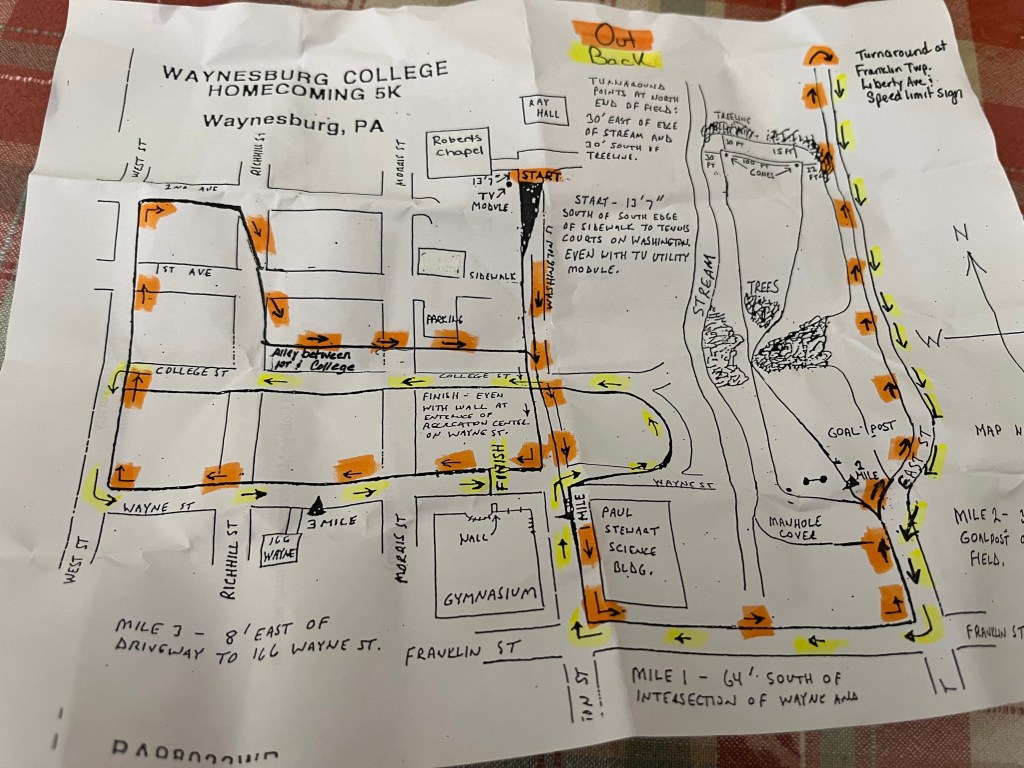
In a spasm of poor decision making, I let my son talk me into signing us up for the Waynesburg Homecoming 5K, which was held early yesterday morning on campus.
I’d never participated in the race before. The course looped through campus and spilled a little beyond. Past Martin Hall … our freshman dorm. Up the hill past the bottom of Buhl Hall … where all our English classes were held. Made a left at the corner where Scott’s used to be before it was torn down way too soon so many years ago.
Aside from a few alumni starting to mill about, it was just a regular day on campus.
I took note of that.
With one notable exception.
When we’d arrived early before the race I saw a sign listing the schedule of events for Homecoming weekend.
Where I learned that they were dedicating the Alumni Walk at 9:45 a.m. … not far from where the race finished up.
Of course they were.
While Peter waited in the gym after the race for the awards to see how he did in his age group (he won), I walked over to the space between Miller and Hanna halls just as the ceremony was beginning.
I’ve spent exactly one day in London in my life. It’s been a couple decades now. I was part of a group at my company attending a conference in Amsterdam (a story for another time). We had to connect through London so ended up taking a day there before continuing on. I believe it was a Saturday. We spent the entire afternoon walking the city, and at some point happened upon an outside street fair.
I only remember two things from that afternoon.
One, an older man playing violin in the square. His hair long, gray and wild, his beard shaggy. Wore a white, long sleeved buttoned shirt, open at the chest and a little grimy, deep burgandy pants that billowed and made his long legs seem longer. He played with passion, his eyes wide when they weren’t closed in communion with his instrument. I took him for a regular, if uninvited, character of the grounds. He was both oblivious and superior to the townspeople and tourists milling about. He danced as he played, in essence commandeering the entire square as his performance space. I was bewitched by his power and presence. He said not a word, yet the square was his.
The only other thing I recall from the street fair was a vendor standing behind a few really long tables of used books. Being a provincial kid from Uniontown on my first trip abroad, I remember being drawn to something familiar in this otherwise exotic place. While my colleagues explored elsewhere, I lost myself rooting through the tables. After a bit, my eye caught something by Kurt Vonnegut. I didn’t recognize the title. It looked to be some sort of television screenplay. I immediately thought of my friend, Bill, who was absolutely mad for all things Kurt. I forked over a couple pounds, put the treasure in my coat pocket, and went to find my colleagues.
When I got home, I wrapped up the book and sent it to Bill, along with a note of how I’d happened upon it.
A week or so later, he wrote me back. Evidently, he’d heard of the screenplay, but it had long been out of circulation. It was the one piece of Vonnegut he’d never been able to track down. He was absolutely over the moon and profuse in his gratitude.
Reading his thank you note was just the best feeling. To this day, I count it among the best gifts I’ve ever given, everything about it pure serendipity.






 Letters for Maggie